Everyday Food Safety
Food Defense – Your Shield for Protecting Food Business and Global Food Supply
What is food defense?
Food defense consistently prevents intentional contamination of food. While food safety relies on HACCP Plans to address unexpected hazards, food defense actively protects public health, operations, and brand image from deliberate harm.
Main threat categories:
- Sabotage occurs when someone tries to harm a product or equipment on purpose
- Terrorism, meanwhile, is when people want to cause fear or widespread harm using food.
- Food fraud (EMA) is when people cheat for money by altering, adding water, or mislabeling food, which can be unsafe.
Why does food defense matter?
By applying food defense, you protect consumers and, importantly, uphold brand trust. Additionally, you meet regulatory requirements (e.g., FDA/FSMA, Codex/EU), thereby lowering the risk and expense of recalls and investigations.
During audits, ensure that you present a well-written plan, a current vulnerability assessment, mitigation actions with owners and due dates, training records, and drill and recall test results.
What are the types of attackers?
1) Disgruntled Employees (Insiders)
Unhappy workers who know the company’s operations and might take advantage of weak spots.
Practical example: a recently disciplined operator repeatedly accesses an open-product step during an unsupervised pause, bypassing a simple rule.
Primary controls include:
- People: foster a respectful culture, ensure lawful pre-hire screening, enforce strong offboarding procedures (including the prompt return of badges and keys), and provide anonymous reporting options.
- Physical: use least-privilege badges, enforce a two-person rule in open-product zones, lock chemical and tool storage, and, indeed, maintain operational CCTV.
- Process: conduct a weekly review of access logs, use incident playbooks, and track Corrective Action and Preventive Action (CAPA).
What to review:
- Do you review badge exception reports every week?
- Do you reconcile chemical and tool sign-out logs each day?
- Do you actively enforce the buddy system during changeovers and breaks?
KPIs:
- Percent of access anomalies closed in 5 business days – meaning, out of all unusual or suspicious access incidents, what % are investigated and resolved within five working days?
- Percent of open-product shifts with buddy coverage – the percentage of work shifts where, whenever the food is exposed (not sealed or opened), two people are present together, making it less likely for someone to tamper with the food.
2) Criminals (Financially Motivated)
Criminals target vulnerable targets for profit—counterfeit goods, diluted ingredients, stolen products, and falsified COAs.
Practical example: a cheap shipment of a high-value spice arrives with a suspicious Certificate of Analysis (COA) and an inconsistent sensory profile.
Primary controls:
- Suppliers: risk-based approval, performance scoring, re-approval schedule.
- Materials: Conduct seal checks during hand-offs and perform risk-based authenticity testing for high-risk commodities.
- Logistics: vetted third-party logistics providers, GPS or route verification for sensitive loads, and sealed custody logs.
What to review:
- High-risk ingredients covered by a Vulnerability Assessment and Critical Control Points (VACCP)/Economically Motivated Adulteration (EMA) assessment?
- Does receiving verify the COA, seal, and count against the Purchase Order (PO) each time?
- Mock traceability tests completed within target hours?
KPIs:
- Seal discrepancy rate – how often do we find broken or missing seals on deliveries?
- Traceability “test-to-proof” time – how long do we track a product from where it started to where it should end up, and prove it went through the proper steps.
3) Terrorists/Extremists (Ideological)
The frequency is low, but the impact can be severe. Attackers focus on leverage points that create a significant downstream effect.
High-level practical example: Attempts to obtain floor plans and batch sizes for bulk mixing to understand the potential impact.
Primary controls:
- Vulnerability Assessment (VA) using CARVER+Shock to prioritize and strengthen high-impact steps.
- Dual-person access and supervision in high-risk zones.
- Crisis communications and intentional adulteration drills.
- Liaison points for regulators and law enforcement.
What to review:
- Do high-impact steps include additional controls (dual-access, CCTV, seals)?
- Do you close drill CAPAs on time?
KPIs:
- Conduct regular practice drills (such as emergency or intentional adulteration drills) to ensure the food defense plan operates effectively.
- CAPA closure time. How quickly do you resolve a problem once identified? Measure the time from when you assign a corrective or preventive action to its completion.
- Percentage of high-impact steps with dual control: What portion of your most critical or high-risk steps enforce dual control? Track the rate of steps requiring two people to be present, which enhances security and reduces the risk of tampering.
4) Competitors (Reputation/IP abuse)
Rare but possible—counterfeiting, brand misuse, or IP theft can lead to serious safety and trust issues.
Practical example: Counterfeit packaging discovered in market channels, posing a threat to traceability and consumer safety.
Primary controls:
- Anti-counterfeit packaging feature: controlled artwork.
- NDAs, “no-photo” zones, escorted tours.
- Verified vendor lists and managed sample programs.
What to review:
- Packaging specs include overt/covert security features?
- Are Visitor NDAs, escort logs, and restricted routes enforced?
KPIs:
- Number of brand-misuse takedowns
- % of tours with NDA and escort documented – this indicates the % of tours where visitors signed a Non-Disclosure Agreement (NDA) and were accompanied by an escort, with both actions duly documented.
5) Opportunists (Low-Skill Exploiters)
People take advantage of easy mistakes—propped doors, unattended ingredients, unlocked rooms.
Practical example: a driver follows too closely through an unsecured door into a restricted staging area.
Primary controls:
- Door discipline, alarms, clear signage, and visitor escort policy.
- 5S/visual controls so anomalies stand out.
- Conduct brief “micro-audits” at the start of each shift to verify doors, seals, and open-container rules.
What to review:
- Doors latched, not propped? Do you always escort visitors?
- Open-product/additive policies posted and followed during breaks?
KPIs:
- Door-alarm events per month.
- % of visitor entries with full escort trail.
Threat Sources
1) Physical Threats
Deliberate foreign objects (e.g., metal fragments, glass, needles) or interference with guards/sieves/magnets.
Example: A broken viewing window near an open mixer can release glass fragments, increasing contamination risk.
Controls: guarded equipment; validated sieves/magnets/metal detectors; tamper-evident covers and hatches; tool custody logs.
Audit prompt: Are detectors and magnets challenged at defined intervals, with records kept?
2) Chemical Threats
Intentional use of toxic chemicals or allergens, or misuse of cleaning agents and additives.
Example: unlabeled decanted chemicals stored near ingredients.
Controls: locked chemical rooms, color-coded containers, a “no decanting” policy, validated allergen changeovers, and line clearance.
Audit prompt: Do you lock, label, inventory, and reconcile chemical stores?
3) Biological threats
Deliberate use of pathogens or toxins, hazardous at post-kill/RTE steps.
Example: recurring environmental hits in a high-care room after layout changes.
Controls: Zoning with pressure differentials, strict sanitation and pre-operation protocols, environmental monitoring, targeted deep cleans, and post-kill segregation.
Audit prompt: Does EMP trending drive corrective actions and re-testing?
4) Cyber Threats
Attacks on IT/OT that alter recipes, set-points, traceability, or access.
Example: Unauthorized remote access changes a temperature set point.
Controls: Multi-factor authentication (MFA), least privilege, network segmentation between IT and OT, change control logs, offline or immutable backups, and tested recovery.
Audit prompt:
Do you enforce Multi-Factor Authentication (MFA) for admin and remote access across both IT and OT systems?
5) Supply Chain Weaknesses
Suppliers, logistics providers, and third-party handlers must undergo documented approval and risk assessments to ensure compliance with relevant regulations. A robust Food Traceability System strengthens food defense by enabling rapid recalls and verifying the integrity of the supply chain.
Example: An imported shipment of spices arrives with a broken seal and mismatched lot documents.
Controls: risk-based supplier approval and audits; seal custody at each hand-off; GPS/route verification for sensitive loads; targeted authenticity testing.
Audit prompt: Do receiving logs reconcile COAs, seals, counts, and temperatures each time?
Food Defense Vulnerability Assessment (VA plan) — Step-by-step Guide
Step 1: Map facility & process flow
What to do: maintain a version-controlled layout showing zones (raw/high-care/RTE), open-product steps, utilities, access points, bulk tanks, and rework loops.
For example: receiving → storage → prep → mixing → thermal step → cooling → packaging → warehouse → dispatch.
Evidence: dated map, legend, and trained staff. Mapping should also consider facility layout and zoning in line with Good Manufacturing Practices (GMP).
Step 2: Identify vulnerable steps
What to do: flag steps involving open product, large aggregation (bulk or batching), limited supervision, or utility interfaces. Include breaks and changeovers.
For example, open mixing and rework staging receive “high” candidate flags.
Evidence: a shortlist or small selection of the best or most suitable choices.
Step 3: Score risks with CARVER+Shock
Actions: Have the cross-functional team assign scores of C, A, R, V, E, R, and +Shock (1–10) to each shortlisted step, and record the rationale.
Example: A total of 59 indicates a critical or high level; a rework staging total of 51 indicates a high level.
Evidence: Signed score sheets and meeting notes.
Who should do the scoring?
Food Defense Team – Ideally, a cross-functional team made up of:
- QA / Food Safety Manager (leads the process)
- Production and Process Manager / Supervisors
- Security Manager
- Maintenance / Engineering Rep (for facility vulnerabilities)
- HR Rep (for insider threats like disgruntled employees)
A team approach ensures scoring is fair, unbiased, and not based solely on one person’s opinion.
Step 4: Prioritize critical points
What to do: sort by total; set thresholds (e.g., ≥60 critical; 45–59 medium). Create a “top-10” register with owners and due dates.
Example: Assign a production manager to oversee mixing mitigations and security, including access upgrades.
Evidence: Risk register dashboard.
Step 5: Apply Mitigation Strategies
What to do: Implement layered controls across physical, procedural, technical, and cultural areas to reduce Accessibility, Vulnerability, Recognizability, and enhance Recoverability.
Evidence: SOPs, PMs, access lists, training logs, and effectiveness checks.
Step 6: Document & Update
What to do: Conduct annual reviews and follow up after changes, such as layout, suppliers, or incidents, to ensure ongoing effectiveness. Perform recall/IA drills and close CAPAs with deadlines.
Example: A new spice supplier prompts re-scoring and an authenticity test plan.
Evidence: Version history, drill reports, and management review minutes.
Food Defense Assessment Plan (How You Run the Program)
- Who monitors each step: assign specific owners — warehouse for receiving seals and COAs, production for supervising open products, QA for testing and verification, and security for CCTV and access control.
- You confirm risks by conducting and documenting weekly CCTV spot checks, reviewing monthly badge exceptions, performing allergen swabs after cleaning, and auditing seals at both receiving and dispatch locations.
- Corrective actions: when a control fails (e.g., broken seal, missing log, offline camera), hold the affected product, investigate, implement CAPA, retrain if needed, and document closure dates.
- Audit frequency & review: Conduct internal audits every quarter using your checklist; hold an annual management review to reassess VA items, update training, and allocate funds for mitigations.
Mitigation & Prevention Strategies
- Enforce access by requiring zone badges and escorting all visitors at all times. Clearly mark no-photo areas to maintain compliance.
- Install CCTV surveillance in high-risk zones, schedule camera maintenance, and ensure that emergency exit alarms function properly.
- Train employees with quick, scenario-based refreshers; empower them to “see something, say something”; and protect reporters from retaliation.
- Vet suppliers: implement risk-based approvals, conduct audits and re-approvals; include contract clauses for transparency and unannounced audits.
- Use FIFO/FEFO to minimize idle periods that opportunists can exploit; verify proper rotation during audits.
- Crisis plans: conduct mock recalls and deliberate adulteration drills; keep contact trees for regulators and customers up to date; have pre-approved public statements ready.
- Cleaning and Sanitation: Effective Cleaning and Sanitation also make intentional adulteration more difficult by eliminating residual risks.
Benefits of Food Defense
- Consumer trust: visible controls and audit results enhance customer and buyer confidence.
- Compliance: programs align with FDA FSMA and Codex/EU standards; audits run smoothly.
- Financial protection: prevention is more cost-effective than a recall; insurance and customer agreements might require it.
- Market advantage: readiness frequently secures tenders and facilitates exports; documented VA with CARVER+Shock indicates maturity.
Conclusion
Food defense isn’t just about compliance—it’s a strategic investment that maintains consumer confidence, adheres to global standards, and protects your market reputation. Ultimately, strong food defense programs safeguard the health of your consumers, the resilience of your business, and the future of our global food supply.
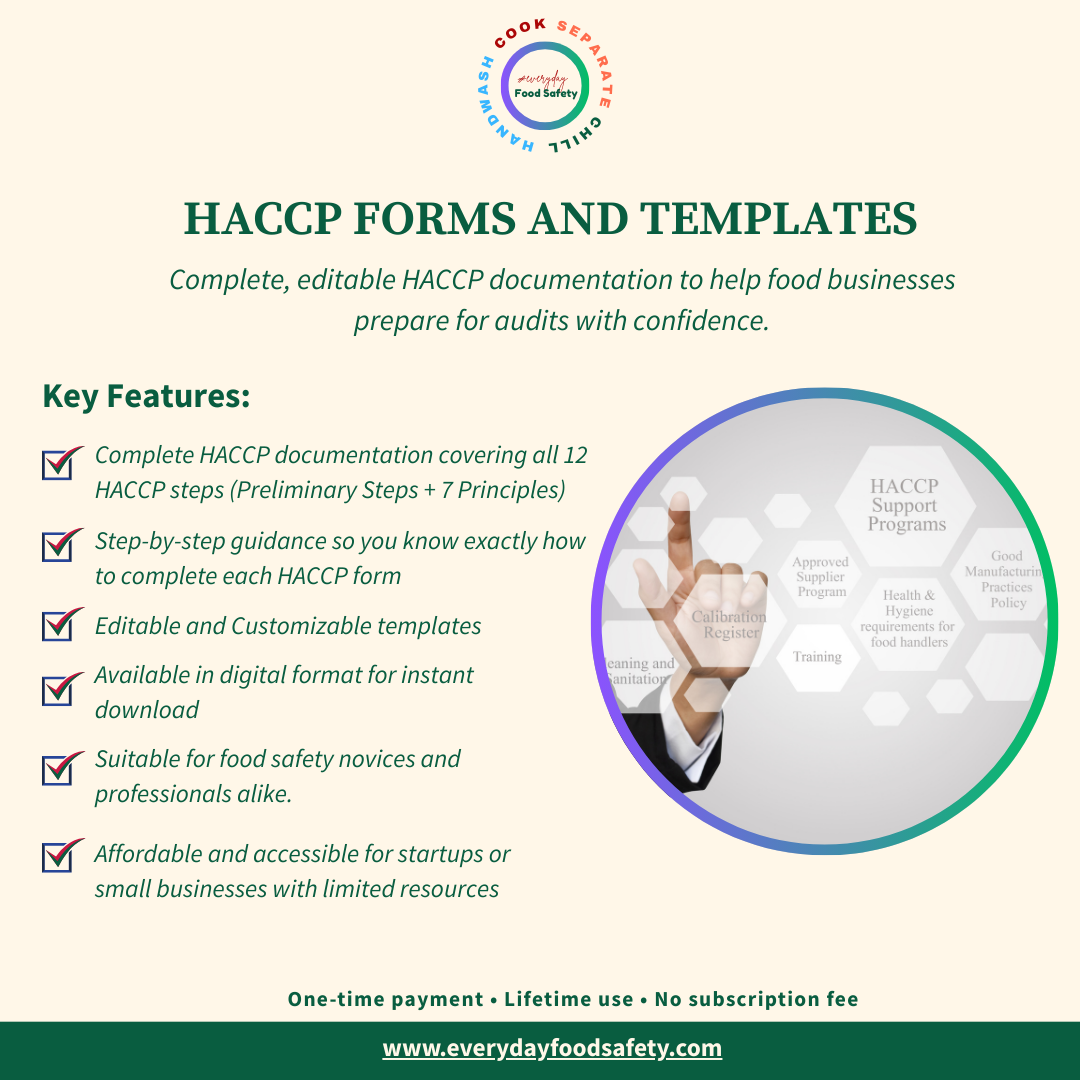
Don’t leave your brand and food business reputation to chance. For a comprehensive approach, review our HACCP Plan Guide in conjunction with the Food Defense Guide and our Food Defense Audit Checklist, and use the CARVER+SHOCK Tool now to identify and address vulnerabilities before they become public.
Now is the time to prioritize food defense as a visible, actionable effort—because the safety of what we eat matters to everyone, everywhere.
Key Takeaways:
- Food defense is a proactive strategy designed to prevent intentional food adulteration, ensuring public health and brand protection.
- Key threats include sabotage, terrorism, food fraud, and opportunistic acts by insiders or competitors.
- Implementing a food defense plan meets regulatory requirements, enhances consumer trust, and lowers recall risks.
- Utilize vulnerability assessments and layered controls to address potential threats throughout the supply chain.
- Regular audits and training improve food defense effectiveness and ensure compliance with global standards.
External Reference
Internal Reference