Everyday Food Safety

ISO 9001:2015 Quality Management System- Each Clause Explained
Many organizations claim to follow ISO 9001:2015 QMS. However, during audits, one question changes everything:
“Can you show me the evidence?”
ISO 9001:2015 QMS focuses on risk-based thinking, leadership involvement, and continuous improvement. Although the standard reduced mandatory procedures compared to older versions, it still requires clear, documented evidence.
Let’s break down each clause — clearly, practically, and audit-ready.
Clause 4 – Context of the Organization
Clause 4 requires you to understand your organization’s environment. You must identify internal and external issues, determine interested parties, and define the scope of your ISO 9001:2015 Quality Management System (QMS).
In short, you must clearly define where your QMS applies and what influences it.
📌 2024 Amendment – Climate Change Consideration
In February 2024, ISO introduced an amendment to ISO 9001 that requires organizations to assess whether climate change is a relevant issue in their organizational context (Clause 4.1).
In addition, Clause 4.2 now requires organizations to assess whether interested parties have climate-related requirements.
This does not mean every company must build a full environmental management system. However, it does mean you can no longer ignore the topic.
You must formally assess and document whether climate-related risks or expectations affect your Quality Management System.
For example, ask yourself:
- Could extreme weather disrupt your operations or logistics?
- Are suppliers vulnerable to climate-related instability?
- Do customers expect sustainability commitments?
- Are new regulations introducing climate-related compliance obligations?
If climate change is relevant, include it in your risk-based thinking process under Clause 6.
If it is not relevant, clearly document your evaluation and justification.
Auditors are not looking for environmental perfection. They are looking for documented consideration.
Required Documents / Records as Evidence
To fulfill Clause 4 (including the 2024 amendment), you should maintain:
- SWOT analysis or context analysis report
- Climate change relevance assessment (documented evaluation)
- Register of interested parties and their requirements
- Legal and regulatory register (if applicable)
- Defined scope of the QMS
- Process map or process interaction diagram
- Quality Manual (optional but helpful)
Without a defined scope, your QMS lacks direction.
Clause 5 – Leadership
ISO 9001:2015 QMS places strong accountability on top management. Leaders must actively support the QMS, promote a customer-focused approach, and ensure roles are clearly defined.
This clause prevents the QMS from becoming “just a quality department task.”
Required Documents / Records as Evidence
- Approved Quality Policy
- Organizational chart
- Defined roles and responsibilities
- Communication records of quality objectives
- Management meeting minutes
- Evidence of leadership involvement
If leadership does not drive the system, compliance becomes weak.
Clause 6 – Planning
Clause 6 of ISO 9001:2015 QMS introduces risk-based thinking. Organizations must identify risks and opportunities that could affect product or service quality.
Additionally, companies must establish measurable quality objectives.
Required Documents / Records as Evidence
- Risk and opportunity register
- Action plans addressing risks
- Quality objectives with measurable KPIs
- Monitoring records of objectives
- Change management records
Planning protects your system from predictable failures.
Clause 7 – Support
This clause ensures the organization has the resources needed to maintain the QMS. It covers competence, awareness, infrastructure, and document control.
Simply put, you must support your system with people, equipment, and structured documentation.
Required Documents / Records as Evidence
- Training needs analysis
- Training attendance records
- Competency matrix
- Equipment calibration records
- Preventive maintenance logs
- Communication procedure
- Document control procedure
- Master list of controlled documents
- Document revision records
Auditors frequently review this clause because poor document control can lead to significant nonconformities.
Clause 8 – Operation
Clause 8 controls how products and services are delivered. It ensures that operations are planned, controlled, and monitored.
Required Documents / Records as Evidence
- Standard Operating Procedures (SOPs)
- Work instructions
- Customer contracts or agreements
- Design and development records (if applicable)
- Approved supplier list
- Supplier evaluation records
- Incoming inspection reports
- Production monitoring records
- Product release approvals
- Nonconformance reports (NCR)
- Corrective action records
This clause typically generates the most audit findings.
Clause 9 – Performance Evaluation
You must measure, analyze, and evaluate system performance. This clause ensures you monitor customer satisfaction, conduct internal audits, and hold management reviews.
Without evaluation, improvement becomes impossible.
Required Documents / Records as Evidence
- KPI monitoring records
- Customer feedback surveys
- Complaint logs
- Internal audit program
- Internal audit reports
- Audit corrective action records
- Management review meeting minutes
- Review of quality objectives
Internal audits are mandatory, not optional.
Clause 10 – Improvement
Clause 10 focuses on continuous improvement. Organizations must address nonconformities, investigate root causes, and prevent recurrence.
Improvement is not reactive. It must be systematic.
Required Documents / Records as Evidence
- Nonconformity reports
- Root cause analysis documentation
- Corrective action reports
- Effectiveness verification records
- Improvement project records
- Trend analysis reports
Organizations that embrace Clause 10 go beyond compliance — they build long-term excellence.
Summary of Mandatory Documented Information of ISO 9001:2015 QMS
Although ISO 9001:2015 does not prescribe a long list of mandatory procedures, you must maintain documented information for:
- Quality Policy
- Quality Objectives
- QMS Scope
- Operational controls
- Competence and training
- Monitoring and measurement
- Internal audit
- Management review
- Nonconformity and corrective action
Remember: Documented information can exist in digital or paper format. However, it must be controlled.
Why does ISO 9001:2015 QMS matter?
ISO 9001 is not about passing audits. It is about building a structured, reliable, and customer-focused organization.
When implemented effectively, it:
- Reduces process variation
- Improves customer satisfaction
- Strengthens operational consistency
- Enhances market credibility
- Drives continuous improvement
Quality is not accidental. It should be managed and controlled.
External Reference:
- International Organization for Standardization (ISO). ISO 9001:2015 – Quality Management Systems – Requirements.
Internal Reference:
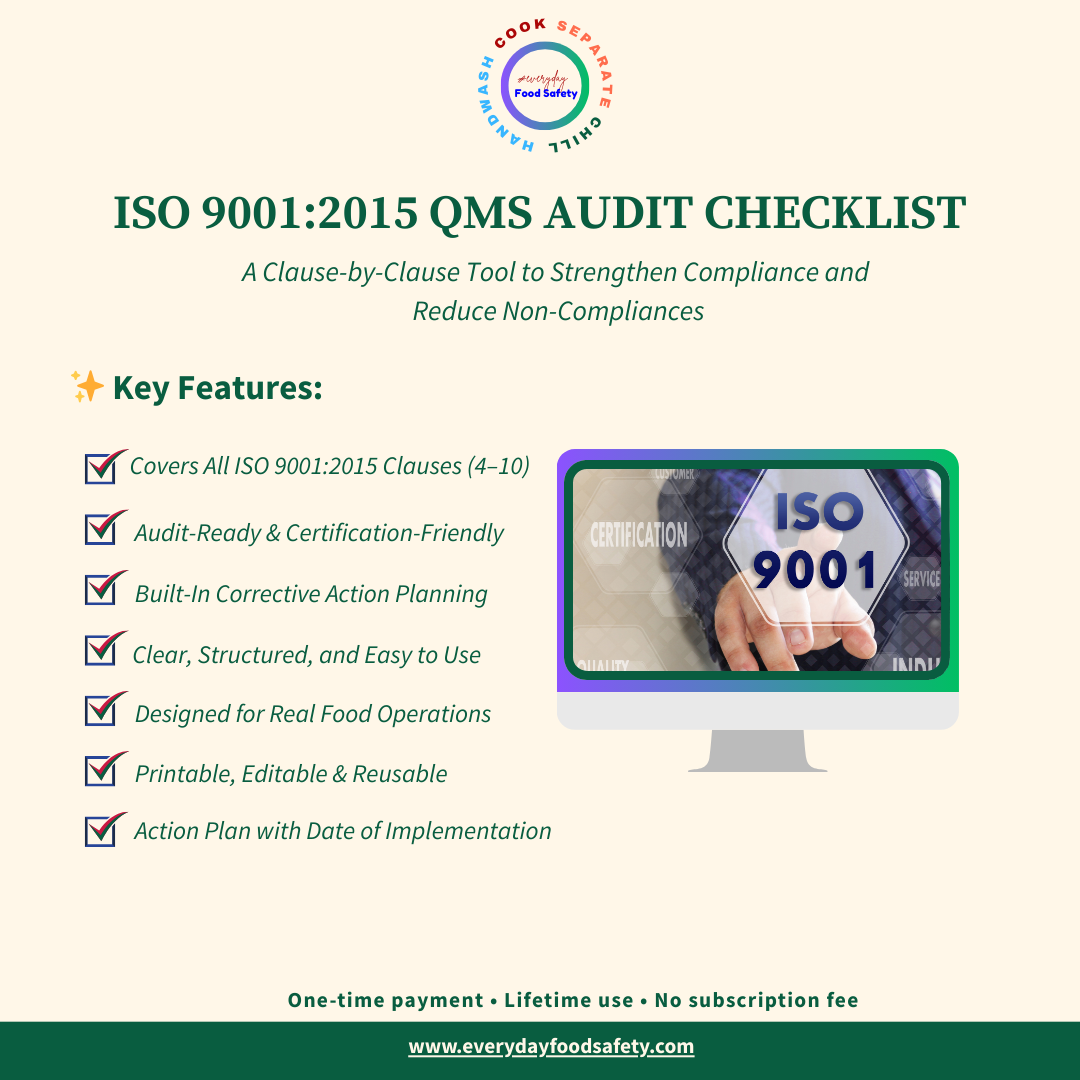
- ISO 9001:2015 QMS Comprehensive Audit Checklist
- GMP for Food Business: The Ultimate Guide to Compliance
- Hazard Analysis and Critical Control Points (HACCP): A Step-by-Step Guide
- Food Traceability
- Cleaning and Sanitation: Key to Food Safety