Halal Raw Materials Receiving Inspection Checklist
$19
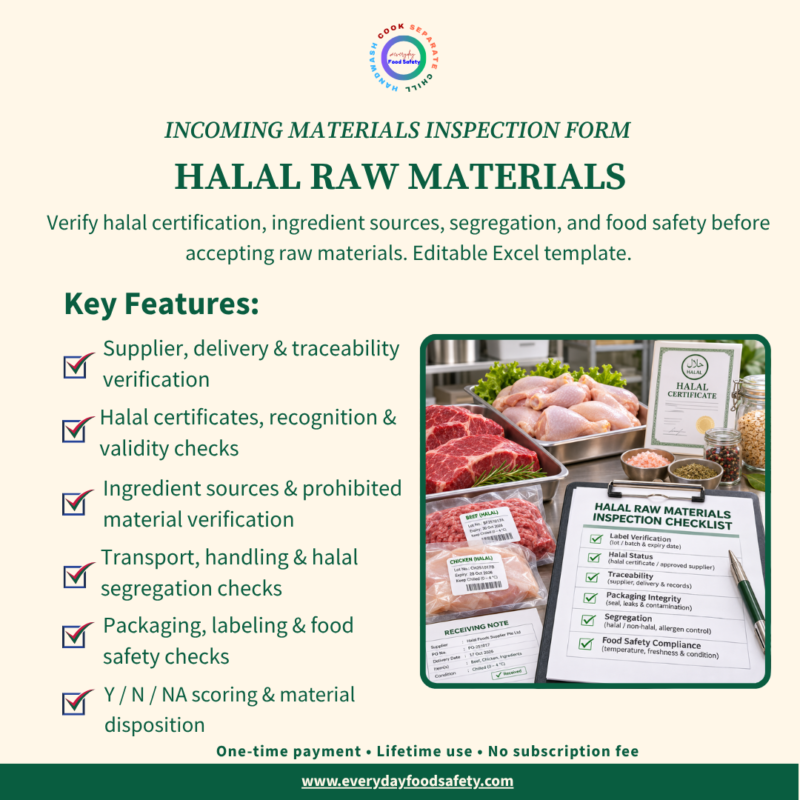
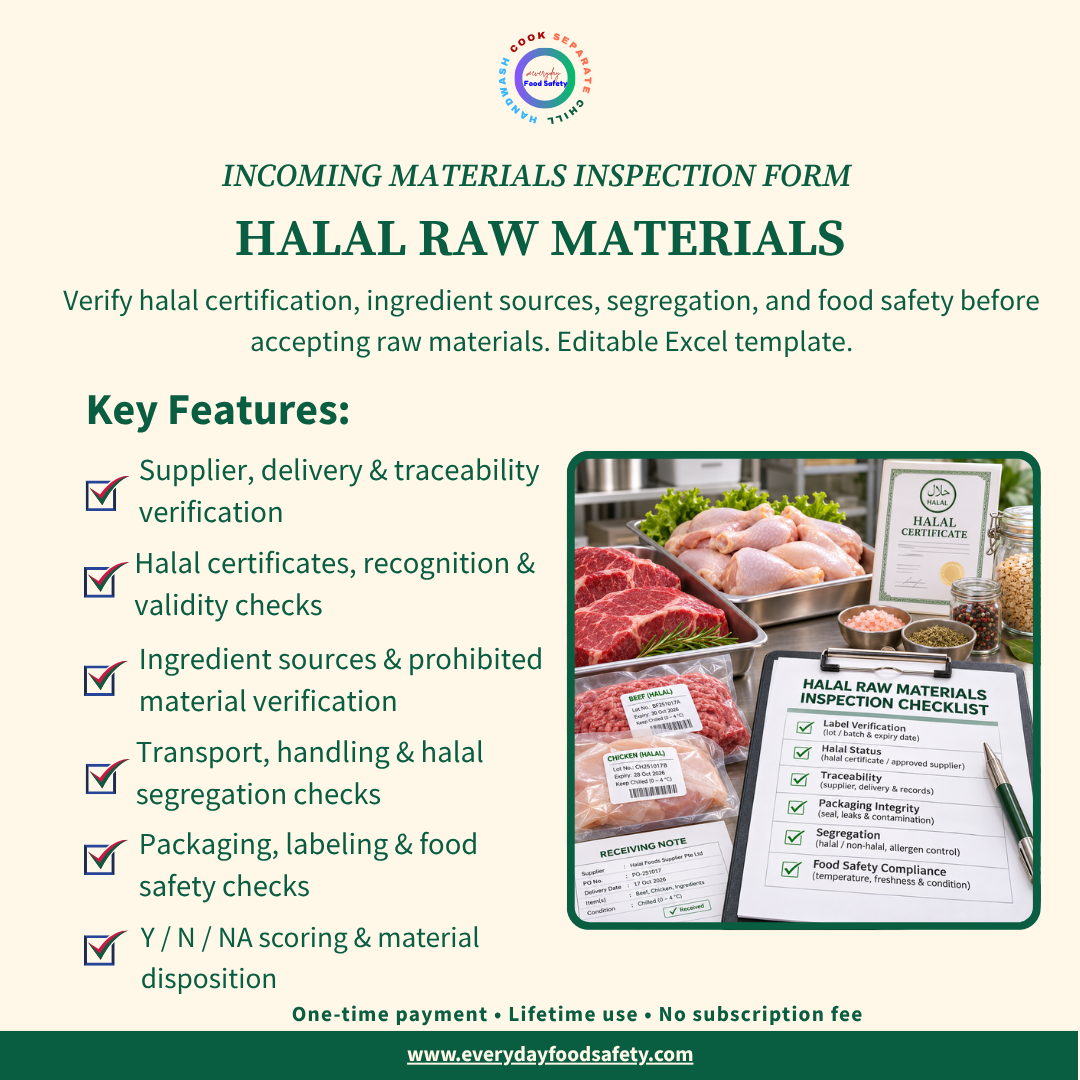
Verify halal certificates, ingredient sources, supplier records, and segregation controls with this Halal Raw Materials Receiving Inspection Checklist.
This editable Excel workbook includes a printable Inspection Checklist and an Instructions sheet. Use the Y / N / NA dropdowns to record findings, track inspection completion, and automatically calculate conformance. Check packaging, delivery conditions, traceability, and halal documentation before deciding whether to accept, hold, or reject incoming materials.
Designed for small food businesses, receiving teams, halal coordinators, and quality professionals who inspect ingredients, blends, additives, and processing aids.
A supplier delivers a food ingredient with a halal certificate. But does that certificate cover the exact material, manufacturer, and production site? What if the ingredient source has changed or the delivery was transported alongside non-halal materials?
Use this Halal Raw Materials Receiving Inspection Checklist to verify supplier documents, ingredient sources, transportation conditions, and halal segregation practices. In addition, inspect packaging, labeling, storage conditions, and traceability records to identify concerns before materials enter production.
The editable Excel template helps your team carry out consistent receiving checks and document inspection findings.
Key Features and Benefits
Inspection Checklist — Review supplier approval, halal documentation, ingredient composition, transportation, packaging, segregation, food safety, and material traceability.
Halal Certificate and Supplier Verification — Check certificate validity, product and manufacturing-site coverage, certifier recognition where required, and relevant supplier records.
Ingredient Source and Halal Status Checks — Review animal-derived ingredients, slaughter documentation, compound ingredients, enzymes, cultures, flavors, processing aids, and other materials that may present halal compliance risks.
Transport and Segregation Checks — Assess delivery vehicle conditions, shared equipment, cleaning records, temperature controls, and measures to prevent contact with non-halal materials.
Y / N / NA Dropdowns and Automatic Scoring — Record inspection results, monitor completion, and calculate percentage conformance while excluding not-applicable checks.
Inspection Summary and Final Disposition — Identify missing requirements, document nonconformances, and record an authorized ACCEPTED, HOLD, or REJECTED decision.
Analytical / Laboratory Test Record — Document additional tests when required, including the test method, results, acceptance limits, and supporting report references.
Instructions Sheet with Reference Sources — Follow practical receiving instructions, understand the scoring system, and review references to Codex, OIC/SMIIC, GSO, and food hygiene guidance.
Want to Improve Your Raw Material Receiving Checks?
When you purchase our digital Halal Raw Materials Receiving Inspection Checklist, please note that no physical item will be shipped. After we deliver the download links, all sales are final. Therefore, you agree that no returns or refunds will be applied once we have provided the access details.
Additionally, this Halal Raw Materials Receiving Inspection Checklist serves as a practical guide to support your compliance efforts. This product does not constitute professional consulting, certification, or regulatory approval services. Use it solely as a reference tool to aid in preparation and continuous improvement.